Bedding · Crib fit and care
A Safer Fit for a Natural Crib Sleep Surface
A crib sleep surface is not improved simply by adding another layer. Before considering a topper, families need to understand the mattress beneath it, the way any accessory fits, and the safe-sleep guidance that applies to an infant’s bed. Materials and maintenance matter—but they come after the most important question: should the topper be there at all?
There is something appealing about the idea of making a baby’s bed more comfortable with a soft, natural layer. Wool, cotton, careful stitching: the words suggest an old-fashioned simplicity, a small retreat assembled with care. Yet a crib is not a miniature version of an adult bed, and the usual language of bedding—plushness, cushioning, pressure relief—does not translate neatly to an infant’s sleep space. Here, the first consideration is not luxury or even material preference. It is safety.
In the United States, the American Academy of Pediatrics recommends a firm, flat, non-inclined sleep surface for infants, with only a fitted sheet. Its safe-sleep guidance advises against soft bedding and other objects in the sleep area. Parents and caregivers should consult current guidance from the AAP and the U.S. Consumer Product Safety Commission, as well as instructions for the specific crib and mattress. If a baby has a medical condition or a clinician has given individualized advice, follow that professional guidance.
That advice is worth putting at the beginning of any discussion of a crib mattress topper. It changes the order of the questions. Instead of starting with, “Which topper feels best?” begin with, “Is an added layer recommended for this infant’s sleep space?” A topper’s organic materials, workmanship, or snug-looking straps do not, by themselves, establish that it is appropriate for infant sleep. Nor does a product description replace public-health guidance.
The safest starting point is the mattress itself
A crib’s mattress should be designed for the crib, fit as specified by the crib manufacturer, and provide the firm, flat surface recommended for infant sleep. The mattress and crib instructions should be treated as a pair of documents, not as paperwork to glance at after assembly. They describe the intended dimensions and use of the sleep surface. If a mattress is damaged, altered, or paired with an accessory that the manufacturer does not approve, the original safety assumptions may no longer apply.
The standard crib mattress dimensions commonly encountered in the United States are about 28 by 52 inches, but that familiar figure is not a substitute for checking the actual mattress and crib. Measurements, corner shapes, coverings, and manufacturing tolerances can differ. A label that says “crib size” does not prove that an accessory will fit a particular mattress. Even a seemingly modest mismatch may produce bunching, looseness, or an uneven surface.
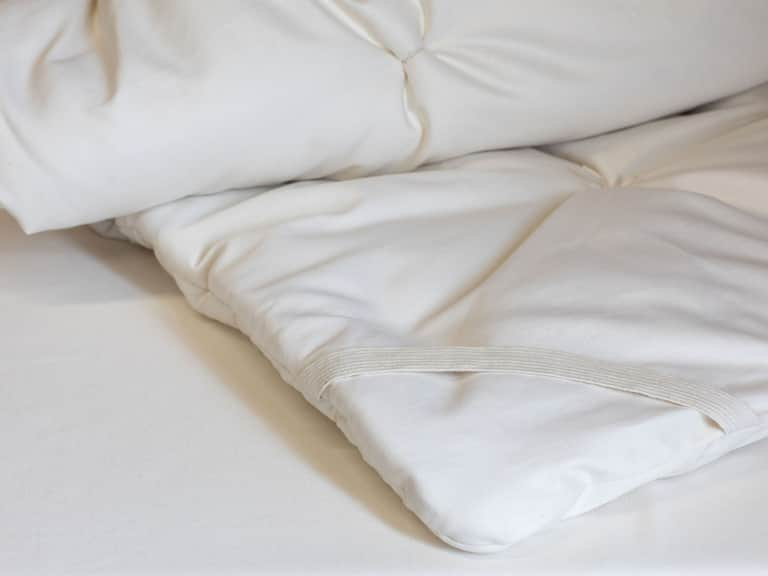
For a crib sleep surface, “fit” is more than a tidy edge. A fitted sheet should be made for the mattress, should not pull free, and should not create loose folds. An additional layer introduces more places for fabric to shift and more construction details to assess. Corner elastic straps may help hold a topper in position, but they cannot establish that the topper is approved for infant sleep or that the resulting surface meets safe-sleep recommendations. A strap is a fastening feature, not a safety certification.
If a mattress topper is being considered for reasons such as a stain, a perceived need for softness, or a desire to make a mattress seem more comfortable, pause before adding it. For routine infant sleep, a bare mattress covered by a properly fitted sheet is the straightforward arrangement recommended by safe-sleep guidance. When there is uncertainty about whether a product can be used with a particular crib, contact the crib or mattress manufacturer—and discuss medical concerns with the child’s clinician rather than trying to solve them with extra bedding.
What materials can—and cannot—tell you
Material information is useful, but it answers a narrower question than safety. Cotton sateen describes a type of woven fabric with a smooth hand. Wool batting describes the fill. A certification such as GOTS, when valid and properly documented, concerns specified organic textile processing and production criteria. These details can help a reader understand how a product is made. They do not mean that the item is suitable for every age, every crib, or every sleep situation.
Wool is valued in bedding for its capacity to take up moisture and for its insulating character. Cotton is a familiar plant fiber used in fabrics and covers. In a quilted construction, stitching or tufting can help keep filling from migrating, while a cover contains the layers. These are relevant features when evaluating workmanship and care. But descriptions such as “breathable,” “hypoallergenic,” or “temperature-regulating” should be read as material or comfort claims, not as a guarantee against overheating, allergy, or other health concerns.
For families choosing household textiles, the source and certification of materials may matter for reasons of preference, environmental values, or sensitivity. A product listing may identify organic cotton, wool sources, or the facility where fabric was finished. Such transparency is valuable, but it should be kept in perspective: an organic label does not alter the basic requirements of a safe infant sleep space. “Natural” is a description of materials, not a synonym for risk-free.
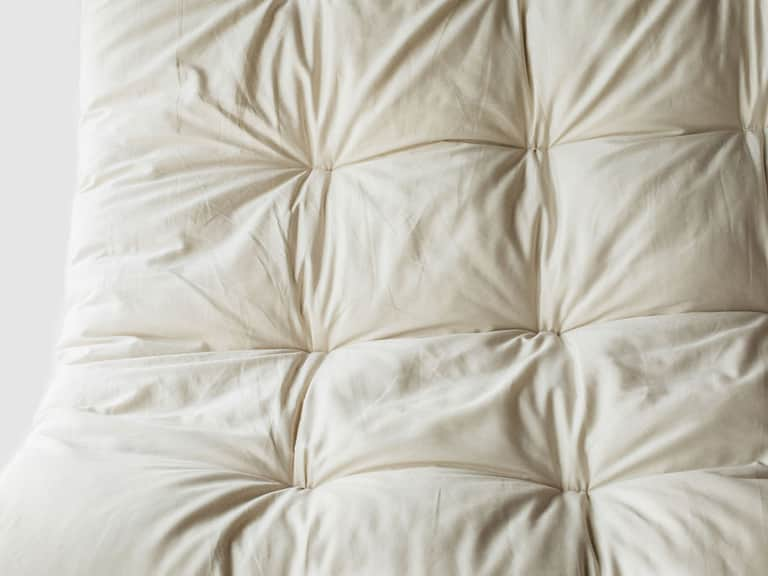
The same distinction applies to construction. Hand-tufting can help hold wool in place within a quilted product. Elastic at the corners can be intended to secure the layer around a mattress. A nominal depth of about one inch and dimensions of 28 by 52 inches are useful specifications to compare with the mattress. None of these details independently confirms that an added topper will preserve the firmness, flatness, or intended fit of the mattress beneath it.
A careful look at crib toppers
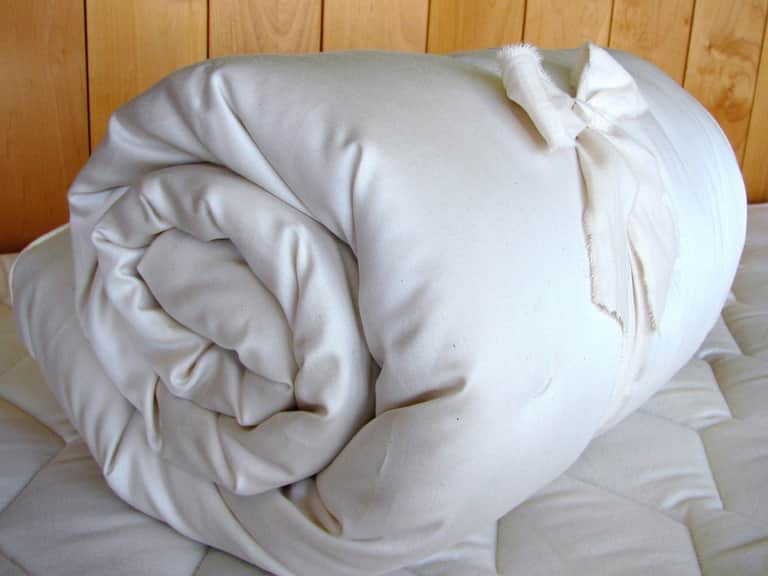
Two products listed in the Bedding category illustrate the kind of information a consumer may encounter. The Certified Organic Crib Mattress Topper is described as a hand-tufted layer with GOTS-certified organic cotton sateen and wool batting, corner elastic straps, and dimensions of approximately 28 by 52 inches with a depth of about one inch. Its care instructions say to spot clean when possible, with cold-water soaking and spinning permitted for large spills, followed by flat air-drying.
The Natural Child’s Crib Mattress Topper is described as quilted, with organic cotton sateen, Premium Eco Wool, hand-tufting, and corner straps. Its listed dimensions are also 28 by 52 inches, at approximately one inch deep. Its care guidance similarly emphasizes spot cleaning, with a limited cold-water soak-and-spin option for larger spills; it says not to use the wash cycle.
These descriptions provide useful facts about fabrics, fill, dimensions, construction, and maintenance. They do not answer the separate question of whether a topper is recommended for an infant’s sleep space. A product may be described as fitting a crib mattress or as being designed for a crib, yet caregivers should still check current safe-sleep advice and the instructions for their crib and mattress before use. If those directions call for a bare mattress and fitted sheet, the product details do not override them.
When assessing any such listing, read the whole description rather than relying on a title or a single reassuring phrase. Look for exact dimensions, materials, cleaning limits, age or use guidance, and any warnings. If the listing does not clearly say what mattress or sleep setting the item is intended for, seek clarification from the manufacturer. Do not infer suitability from the fact that straps are present, that a product is handmade, or that its components carry an organic certification.
Care is part of the decision
A natural-fiber topper may ask for more delicate maintenance than a washable blanket. Wool and cotton constructions can respond poorly to repeated agitation, high heat, or excess water. The care label and manufacturer’s written instructions are therefore not minor details: they define the cleaning methods the maker expects the product to tolerate. If instructions say spot clean, that means spot clean—not a routine trip through the washing machine.
For the products described above, the general approach is to remove a small soiled area with careful spot cleaning and to dry the item fully before it is stored or used again, subject to the exact instructions supplied with the individual product. The Certified Organic Crib Mattress Topper listing permits cold-water soak-and-spin cycles for large spills and specifies flat air-drying; the Natural Child’s listing permits cold-water soak and spin for large spills but says not to use the wash cycle. These are product-specific directions, not universal rules for all wool bedding.
When cleaning instructions seem ambiguous, ask the manufacturer before applying detergent, soaking the item, or using heat. Avoid improvising with bleach, solvents, steam, or direct heat unless the maker explicitly permits them. A topper that remains damp can be difficult to dry thoroughly, and storing any textile before it is dry may lead to odor or deterioration. Keep cleaning products and the item itself out of a baby’s reach while the work is underway.
Care also includes regular inspection. Look for torn fabric, loose stitching, exposed filling, stretched elastic, or any change in shape. A topper that bunches or no longer lies evenly presents a different fit question from one that is new and intact. But even a well-maintained item is not automatically appropriate for infant sleep. Good upkeep can preserve a product’s condition; it cannot convert an accessory into a medically recommended sleep surface.
Questions to ask before buying or using one
Because a crib setup is a system, a few practical checks can prevent confusion. The answers should be specific, not based on assumption:
- What do the crib and mattress manufacturers say about added layers or accessories?
- Does current safe-sleep guidance support using this item for an infant’s sleep space?
- Are the listed dimensions consistent with the actual mattress, and does the fitted sheet remain secure?
- What are the complete material, construction, and certification details?
- Which cleaning methods are permitted, and can the household follow them reliably?
- Is the product damaged, stretched, altered, or difficult to keep flat?
If one answer is uncertain, the prudent next step is not to test the item by trial and error in the crib. Check with the manufacturers or a qualified clinician, and follow authoritative infant safe-sleep guidance. A retailer’s product description can explain what was made; it cannot replace the directions for the crib, the mattress, or the baby’s care.
Keep comfort and safety in their proper order
Parents often spend an unreasonable amount of time choosing the things that will surround a new child. The effort is understandable. A crib is one of the few household objects whose simplicity can feel almost austere: mattress, sheet, empty space. In a culture that treats comfort as something to be layered on, that plainness may look unfinished. For infant sleep, however, restraint has a purpose. The safest arrangement is not necessarily the one that resembles a miniature luxury bed; it is the one that follows current evidence-based guidance.
That does not make materials or craftsmanship irrelevant. When selecting bedding for other uses, or evaluating how a textile is made and cared for, organic cotton, wool fill, stitching, sourcing, and cleaning instructions can all be meaningful considerations. The key is to keep those considerations in their proper place. They help describe a product; they do not settle whether it belongs in a crib during an infant’s sleep.
A secure fit begins with the crib and mattress specified for one another. A clear understanding of safe-sleep advice comes next. Only then does it make sense to consider a topper—and only if the relevant guidance and manufacturer instructions allow it. Corner straps, careful tufting, and thoughtful natural materials may sound reassuring, but the most reassuring sleep surface is one whose use is appropriate, whose fit is verified, and whose care instructions are understood before bedtime.
This article is for general information and is not medical advice. Safe-sleep recommendations can be updated. Consult current guidance from the American Academy of Pediatrics and the U.S. Consumer Product Safety Commission, follow the instructions for your crib and mattress, and ask your child’s clinician about individual medical concerns.